back to the List of Recipes
Sauerkraut
Sauerkraut is so easy to make you will wonder why you ever bought it at the store.
Yours will taste better, and cost less too!
Ingredients and tools:
Three tablespoons (50 ml) coarse kosher salt
One and one half tablespoons (25 ml) kosher salt for brine
Five pounds (2 kg) green cabbage (2 medium heads)
(You may find a "pillow" of cabbage already shredded for coleslaw at a restaurant
supply or a big-box store like Costco. This will make good sauerkraut and will save you
much of the work.)
A towel or pillowcase that has been very well rinsed to remove any residual detergent
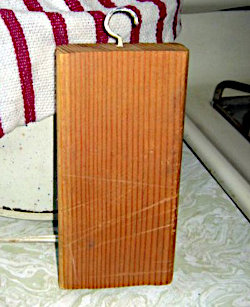
An eight to twelve inch long piece of old 2x4 that is untreated and free from resin or
other tree residues
Method:
Remove and discard outer leaves from cabbage. Rinse heads under cold running water and drain.
Cut heads into eighths and remove cores. With a mandoline, hand grater or sharp knife, shred
or slice to a thickness of about one eighth of an inch.
Place shredded cabbage in container and, using clean hands, mix the salt in well. Pack firmly,
layer by layer, into a clean unheated crockpot or other suitable container tamping as you go by
pressing down hard with the piece of old 2x4 leaving and inch or more of space at the top. If all
the cabbage won't fit in the crock you can rinse the remaining cabbage to remove salt and use it
in some other way.
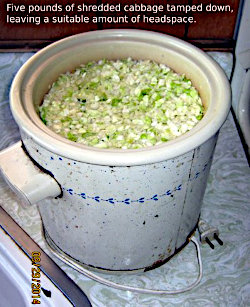
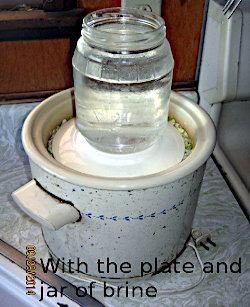
Using a low quart jar (I like to use a pickle jar from the grocery) as a container, prepare a brine
made from one and one half tablespoons kosher salt and one quart water. Set this aside.
Cover the salted cabbage with a clean ceramic plate that just fits inside the crock. Weigh it down
with the quart jar filled with brine to further press down the cabbage. Cover the crock with a
clean, especially well rinsed hand towel or pillowcase.
Over the next 24 hours a brine will form in the crock that will cover or come close to covering
the cabbage. At this point pour as much brine as needed from the jar into the crock to ensure
that the cabbage is fully covered with liquid with about one half inch extra brine submerging the
cabbage and plate. It is essential that the cabbage is fully immersed in the brine. All of the cabbage
must be below the top of the liquid to assure that the fermentation process is happening correctly.
If some of the cabbage is
above the brine it can begin to spoil instead of fermenting properly.
After topping up the cabbage refill the jar with plain water and return it to the plate and cover all
with the towel secured with a rubber band or string. This cloth is to keep insects out.
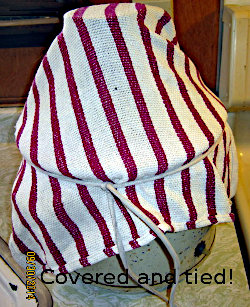
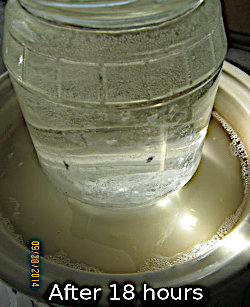
The "After 18 hours" picture shows the cabbage is well covered with brine.
No brine was added:
the cabbage and salt did this without assistance.
Note the bubbles at the rim of the brine.
Fermentation has started.
The cabbage covered in brine will naturally ferment and this fermentation
process which makes
lactic acid, not alcohol, will turn the cabbage into an extremely tart preserved food: sauerkraut.
The saltiness of the brine and the exclusion of air from the cabbage selects for the bacteria that
cause this desirable fermentation and prevents spoilage.
Store in a cool spot between 60F (15C) and 75F (25C) for 3 to 6 weeks. Check the sauerkraut a
few times each week making sure the cabbage is fully immersed. Press down the plate by pressing
down on the jar and watch for bubbles. These bubbles are an indicator that fermentation is
proceeding. Add water as needed to top up. You don't need to add brine: there is enough salt in
the crock already and a slight dilution with water will do no harm. The brine covering the making
sauerkraut will become hazy and a scum may form on the surface. This is normal and nothing to
worry about.
You can taste the making sauerkraut every week or so if you like, but always use clean hands and
utensils and be careful not to contaminate the plate and the bottom of the brine jar. If it spoils,
you'll know it: it will be slimy, discolored and smell rotten. Never taste kraut you suspect has spoiled.
You can tell when fermentation is complete when you can no longer press any bubbles out of the
kraut. It is now time to move the sauerkraut into storage containers (freeing up your crockpot!)
and refrigerating them. Pack the kraut into glass jars or plastic food containers with brine to cover
and refrigerate until ready to use. Refrigerated, it will keep for several months as long as it's covered
by liquid. It will slowly continue to ferment. You may eat it raw as a condiment or drain, rinse and cook.
How much rinsing is needed is a matter of personal taste. I think the only cooking use for unrinsed
sauerkraut and its brine is for simmering hot dogs. I rinse a pint (500 ml) of sauerkraut with one or
two pints of water, draining and pressing it afterward. You will find for yourself how much rinse water
to use to
make the sauerkraut just as tangy as you like it.
This page is copyright © 2014 by Roy Pittman.