page forward page back
Table of Contents Index
Dual Chamber Pacing example two
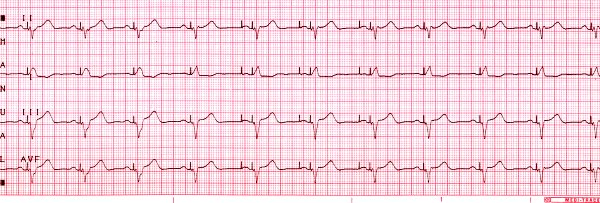
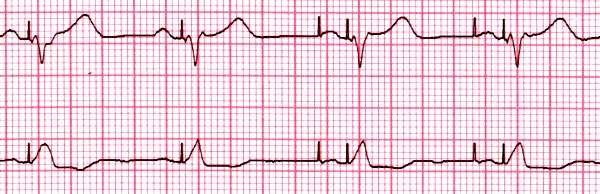
This strip shows a dual chamber pacer
using more of its capabilities. The
first four beats have native
P-waves, and the pacer is sensing these. The
pacer responds by inhibiting
its own atrial stimulating activity. Following
these native P-waves
is a P-R interval that exceeds the pacers preset limit,
which here is
0.17 seconds. The pacer senses this absence of ventricular
activity and stimulates the ventricles, producing a wide QRS complex.
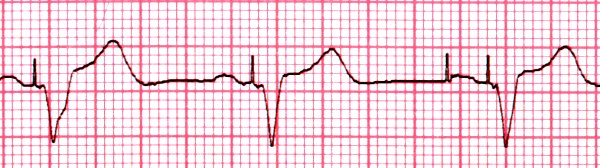
The pacer then waits for the next heartbeat. With the fifth beat,
we see an
R-R interval that exceeds the pacers preset limit of 1.00 seconds.
The
pacer responds by stimulating the atria, and stimulation of the ventricles
follows. This dual chamber stimulation is repeated for the next two
beats,
and then the native atrial rate takes over for the rest of this
strip, with the
pacer providing single chamber (ventricular) pacing.