page forward page back
Table of Contents Index
Dual Chamber Pacing example one
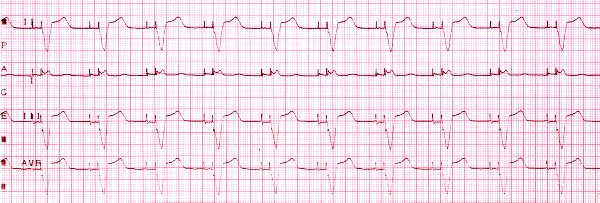
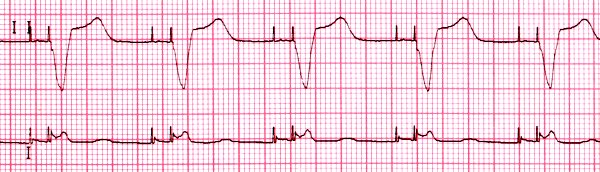
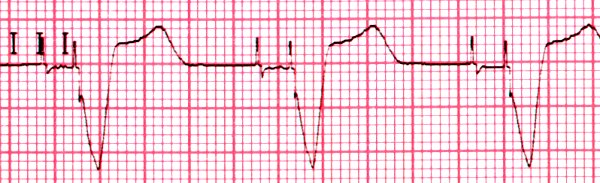
This strip shows dual chamber pacing at its most straightforward.
With each beat, an initial pacer spike is
followed by an oddly shaped P-wave (atrial stimulation and response), there
is a short pause (a predetermined P-R interval, in this case 0.15 seconds
in length), then a second pacer spike is followed by a wide QRS complex
resembling a PVC (ventricular stimulation and response). There follows
another pause, and the cycle repeats. This pacer is set to produce
a beat every 0.96 seconds, producing a heart rate of 62.5 beats per minute.
(It was probably intended to set a rate of 60.) So, we see here sensing
of both the atria and ventricles (in this case sensing of no activity)
and dual stimulation. This pacer was in fact also programmed to respond
to native atrial and ventricular activity by inhibiting its own activity.
Thus, this is DDD pacing.