page forward page back
Table of Contents Index
Ventricular Pacing example two
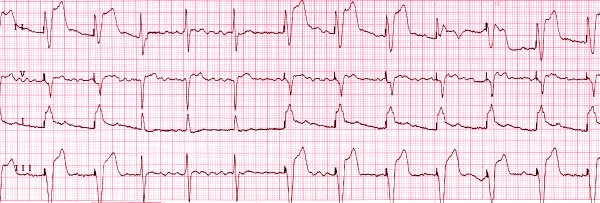
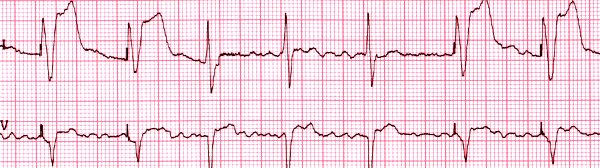
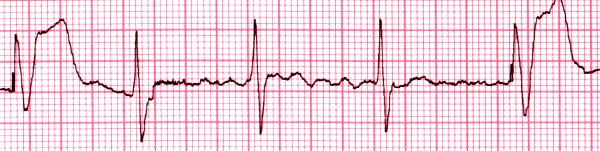
This strip shows ventricular pacing with
an underlying rhythm of fib / flutter.
The first three beats are paced, with an interval between pacer spikes
of 0.84
seconds, so the pacer is set to maintain
a rate of 70 beats per minute. 0.76
seconds after the spike that initiates the third beat, a native beat occurs.
The pacer does not respond to the atrial flutter waves, but does sense the
ventricular activity
and responds by inhibiting itself. So, the pacer is in VVI
(Ventricular stimulating, Ventricular sensing, Inhibition in response to
sensing)
mode. As the underlying rhythm has varying
R-R intervals, the pacer functions
as an on-demand back-up, allowing no R-R intervals longer than 0.84 seconds.
After three native beats this interval is exceeded and ventricular pacing
resumes. After three more paced beats, the R-R interval of the underlying
rhythm happens to
be 0.84 seconds, the same interval the pacer is set on.
A fusion
beat results, where there are two initiating impulses: one from the
pacer and one native impulse. These two fuse, producing a different QRS shape.
Another differently shaped fusion beat follows, and the
strip ends with two
paced beats.