page forward page back
Table of Contents Index
Wandering Atrial Pacemaker
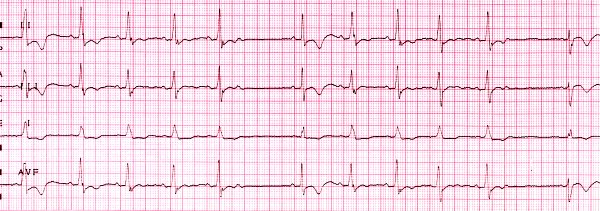
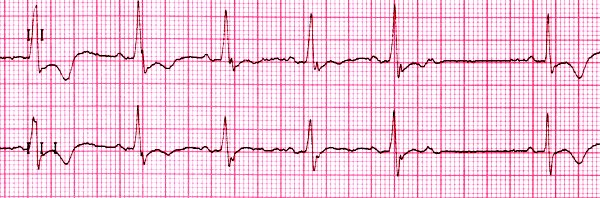
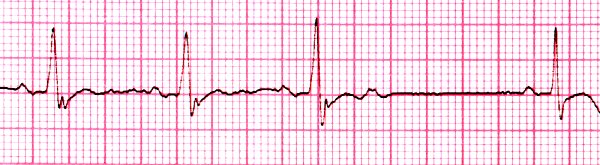
At first glance, this looks like second degree block, and in a sense it is. However, this is not a typical
second degree block: look closely at the P-waves. This is an example of wandering atrial pacemaker
with an interesting feature: twice, an atrial impulse is not propagated through the ventricles because
it arrives while the A-V node is in a completely refractory state. Here is the sequence: a first type of
P-wave, with a P-R interval of 0.12,
is followed by a second type of P-wave. The time interval between
these P-waves, the P-P interval, is 0.83 seconds, and this second type of P-wave, with a P-R interval of
0.14, is followed by a QRS. The
next P-P interval is 0.76, there is a third type of P-wave, with a P-R
interval of 0.16, and then a QRS follows. The next two P-waves are
type 2 and 3 again, with their same
characteristic P-R intervals, and P-P
intervals of 0.75 and 0.72 seconds, followed by QRS complexes.
After this fifth beat, there is a P-P interval of only 0.48 seconds, a fourth type of P-wave, and no QRS. Why?
There has not been enough time for the A-V node to repolarize and become
receptive to atrial stimulation.
It is in its refractory period. This occurs again after the next four beats: a type 4 P-wave is seen after a
brief P-P interval, and no QRS follows. Again, the A-V node is refractory. The intervals between the
preceding Qs and the non-conducted Ps are 0.28 seconds, so the maximum rate this A-V node
will conduct
is about 215 beats per minute.