page forward page back
Table of Contents Index
Second Degree Block Type One example one
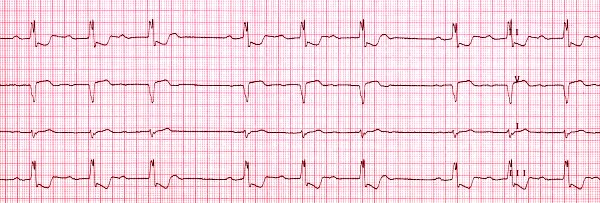
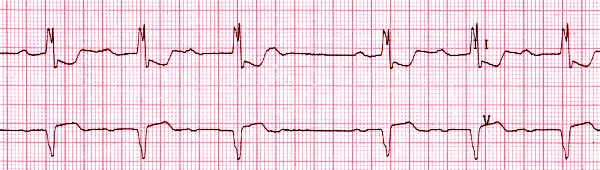
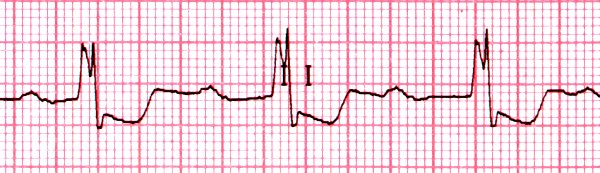
Notice the regular irregularity of this rhythm: groups of three beats follow
one another. Look at the P-R intervals:
all of them are prolonged, but each
successive one in the pattern is longer than the one before. The first is
0.28 seconds, the second is 0.40, the third is 0.48, and the fourth is not
conducted at all. The pattern repeats. The mechanism? A property of the
A-V node is that it can be relatively refractory: it can pass an impulse along,
but with a variable delay. The AV node here is unable
to recover fully in the
time between beats; it is more and more refractory with each beat and thus
the AV nodal delay is greater with each beat, until the node is finally fully
refractory and the atrial impulse is blocked. Thus, the locus of this block is
above the bundle of His. Amazingly, Dr. Wenckebach arrived at this correct
interpretation of the regularly irregular pattern of beats by observing pulses
only - the electrocardiograph had not been invented! This type of block is
more often seen with an inferior MI and is likely to resolve. In the example
seen here, a left bundle branch block is also present, revealing additional
conduction disease below the bundle of His.