page forward page back
Table of Contents Index
Rate Related Bundle Branch Block example one
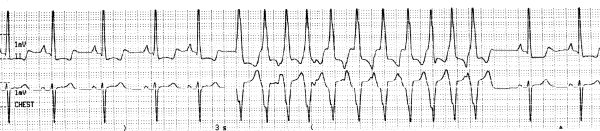
This strip begins with sinus rhythm, a burst of some other rhythm follows,
then sinus rhythm resumes.
What is this intervening rhythm?
It is tempting to call it a run of ventricular tachycardia,
but look
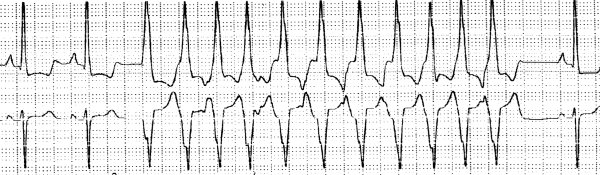
more closely. After the first four (sinus) beats, the QRS
width increases. How wide are these complexes?
Notice that
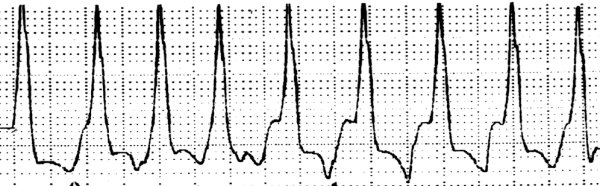
beginning with the fifth wider QRS, there is a shoulder before each complex, and the
shoulder is level with the baseline of the preceding sinus rhythm.
Notice also that the repolarization
segment of the last wide complex includes this shoulder and ends with a return
to the original baseline.
Here then, at the level of this shoulder,
is where the measurement of QRS width should be made.
Every complex preceded by this shoulder has a duration of 0.12 seconds, so these are
not ventricular beats.
What we see here is a burst of atrial
fibrillation: all the R-R intervals are
different. And the widening?
The bundle branches of this
heart functions normally at a slower rate, but have a prolonged refractory
period that becomes apparent at the faster rate. A bundle
branch block, probably left, appears.
This is not VT, it is rate related bundle branch block.