page forward page back
Table of Contents Index
Sinus Bradycardia with Second Degree A-V Block
(Type II) and Intermittent Bundle Branch Block
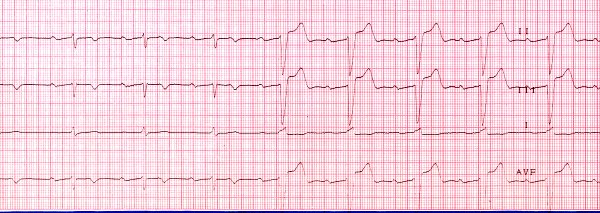
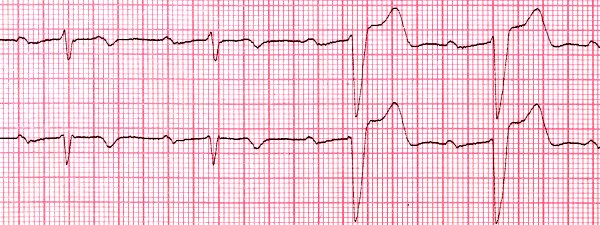
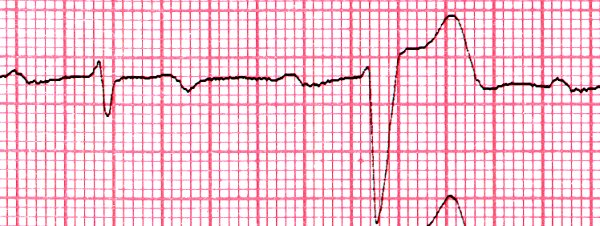
Look at the QRS complexes: there is a marked change halfway through
the strip.
The later complexes might be mistaken for ventricular beats, but they are not ventricular
in origin. Notice that the R-R interval has not changed: it is still about 1.18 seconds,
giving a rate of 51. The QRS has widened from 0.08 to 0.12 seconds, and has changed shape.
Each of these wider complexes is preceded by a P-wave, and the P-R interval is unchanged
at 0.38 seconds. For all these reasons these beats are not ventricular in origin: they are
still sinus beats. The change in QRS
morphology is caused by a bundle
branch block
which is intermittent: sometimes present, sometimes not. It is easy to misinterpret this as VT!
The rhythm here is at first unclear. It is some kind of A-V block, and at first glance seems to
be first degree. Look more closely. If you divide the apparent P-P interval
in half, and march
that interval through the strip with calipers or a ruler, you can see that there is a suspicious
bump in the first three T-waves just where that interval falls. These bumps are probably
P-waves, partially hidden in the T-waves, and the rhythm thus is second degree block, two-to-one
type.