page forward page back
Table of Contents Index
Ventricular Tachycardia example one
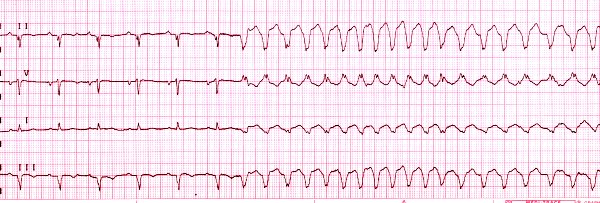
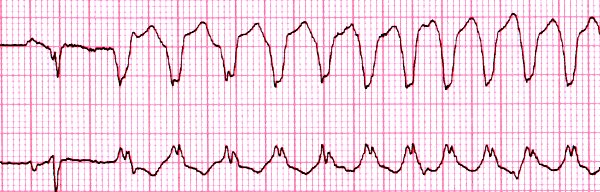
 br>This strip begins with six beats of sinus rhythm. Suddenly this
rhythm changes to a wide-complex tachycardia,
with a rate varying from 160 to 190. It is easy to mis-diagnose ventricular tachycardia
, and optimally a 12-lead EKG should be obtained. However,
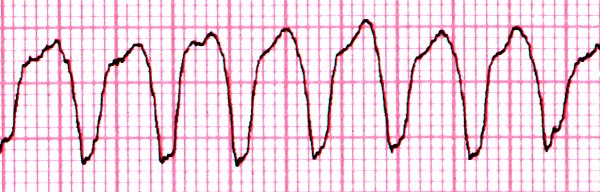
this rhythm strip shows many of the hallmarks of true VT: notice the wide
QRS complex (greater than 0.14 second), the irregular rate, the slurring
from depolarization into repolarization,
and that the repolarization phase is opposite the isoelectric line in every
lead. Also, when the rhythm change occurs, a change in QRS
axis
is seen in some leads, and the QRS shape in V1 is biphasic rather than
triphasic (triphasic would favor right bundle
branch block), with the first rabbit-ear larger than the second.
br>This strip begins with six beats of sinus rhythm. Suddenly this
rhythm changes to a wide-complex tachycardia,
with a rate varying from 160 to 190. It is easy to mis-diagnose ventricular tachycardia
, and optimally a 12-lead EKG should be obtained. However,
this rhythm strip shows many of the hallmarks of true VT: notice the wide
QRS complex (greater than 0.14 second), the irregular rate, the slurring
from depolarization into repolarization,
and that the repolarization phase is opposite the isoelectric line in every
lead. Also, when the rhythm change occurs, a change in QRS
axis
is seen in some leads, and the QRS shape in V1 is biphasic rather than
triphasic (triphasic would favor right bundle
branch block), with the first rabbit-ear larger than the second.