page forward page back
Table of Contents Index
Accelerated Junctional Rhythm example two
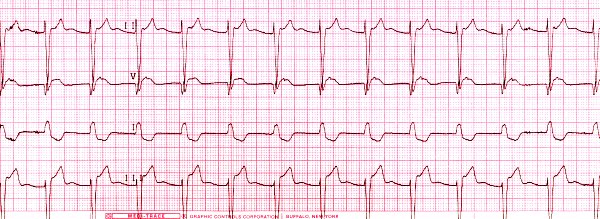
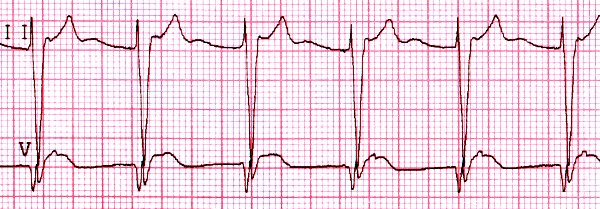
Notice that P-waves don't precede the QRS complexes, and look at the QRS
shape and duration. There are rabbit ears in V with no positive deflections,
and the duration is 0.12 seconds, characteristic of a left bundle branch
block.
This is a junctional rhythm, but the rate is 85 per minute. This is much faster
than a typical junctional rhythm: it is an accelerated junctional rhythm.
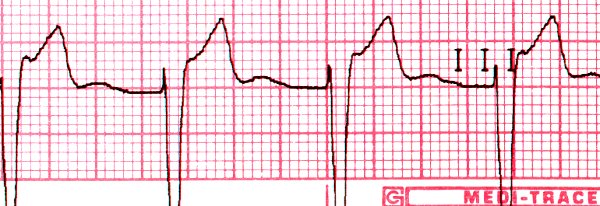
Note the bumps ending the QRS complexes in leads II, III and V: these may be
retrograde P-waves. If the pacemaker is low
in the AV node, retrograde
conduction to the atria is delayed as the impulse
passes through the bulk of
the node, and thus the P-wave appears after the QRS. Also note in leads II
and III that the T-wave is followed by a deflection called a U-wave. This wave
is visible with hypokalemia or can
be a quinidine effect.