page forward page back
Table of Contents Index
Atrial Fibrillation example one


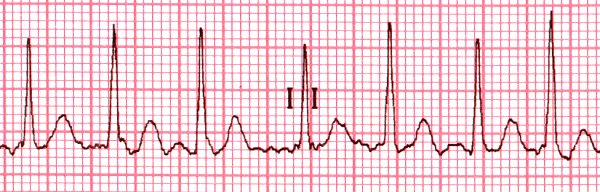
This is classic atrial fibrillation with
rapid ventricular response. Note the
irregular baseline, representing rapidly fluctuating atrial electrical activity,
the absence of P-waves, and the uneven R-R intervals. This unevenness is
said to be irregularly irregular; it has no pattern or order. It is caused by
random excitation of the A-V node, a characteristic feature of atrial fibrillation.
The actual pacemaker here may be a bit of atrial tissue that has been
embedded into the pulmonary artery and whose distance from the atria
varies with the motions of the heart and lungs, producing the irregular rhythm.
The shape of the QRS complexes is normal, indicating an intact conduction
system from the A-V node downward. Normal ventricular repolarization is
indicated by normal T-waves. This is a common rhythm, seen in one per cent
of those over 60 years of age, and in five per cent of those over 65.