page forward page back
Table of Contents Index
Wandering Atrial Pacemaker example one
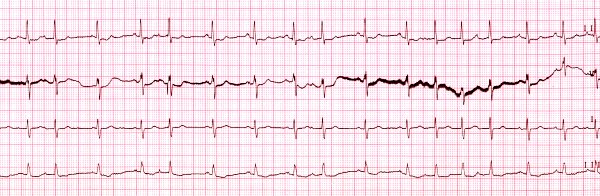
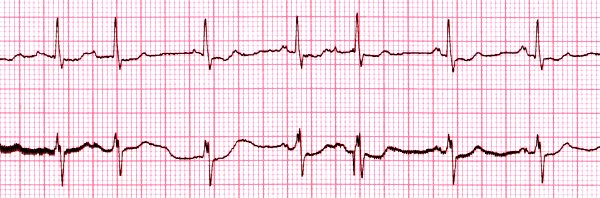
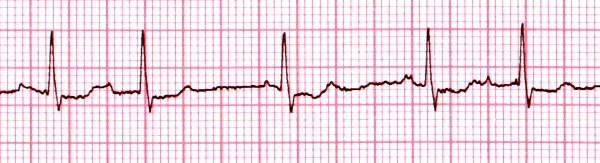
Look at the P-waves and P-R intervals. There are at least four
different P-wave shapes, occurring in no particular pattern, and each of
these four P-waves is followed by its own unique P-R
interval. Why is this happening? The atria have multiple
irritable foci, each firing randomly and independently. The pacemaker
of the heart wanders between these foci, and thus this rhythm gets its
name. Counting off from the beginning, there is a first type of P-wave,
with a P-R interval of 0.16; then a second type of P-wave, with P-R interval
of 0.19; then a third type of P-wave, with P-R interval of 0.10;
and then a fourth type of P-wave, with P-R interval of 0.15 second.
A second occurrence of P-wave type 2 follows, then three of type 4 in a
row, another type 2, then two of type 4, one of type 2, then possibly
a fifth type of P-wave. In each example of types 1 through
4, the characteristic P-R interval associated with each type of P-wave
is seen. Notice also the baseline irregularity in the V-lead:
this is caused by chest wall muscular activity.