page forward page back
Table of Contents Index
Atrial Bigeminy
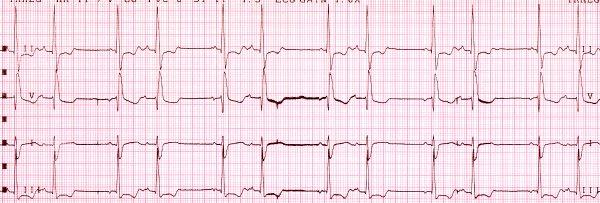
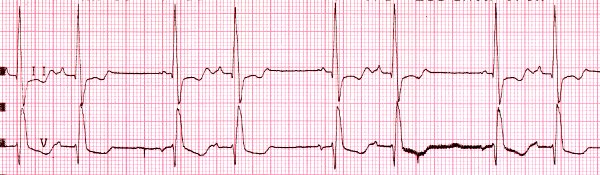
Notice the pattern: a pair of beats, each of the pair fairly normal
looking, occur close together, then a pause, another pair of beats, and
so on. The cause of the pattern: every sinus beat is followed
by a PAC. In effect, there are two atrial pacemakers
acting in alternation here. Every beat has a P-wave initiating it,
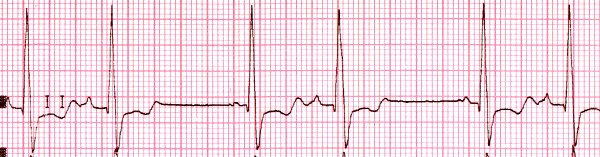
but notice that there are two different and alternating P-wave shapes,
and two alternating P-R intervals as well. The first type of P wave
is followed by P-R intervals of 0.14 second. The intervals between
these R-waves and the next P-waves (the R-P intervals) are 0.65.
The P-R intervals following the second type of P-wave are 0.17, and the
R-P intervals following are 1.10. Notice: a shorter R-P interval
produces a longer P-R interval. Why? The A-V node can be relatively
refractory: it can transmit an impulse after a delay, and this delay
can vary with how refractory it is.
The second beat in each pair demonstrate this: the shorter R-P means
that the atrial impulse reaches the A-V node while it is still partially
refractory, so the P-R interval is longer. Finally, take note
of the widened QRS (0.12 second) and the upward deflection in the V-lead:
these indicate a right bundle branch block.