page forward Table
of Contents Index
This atlas is free for you to use, free from advertising, and will stay that way.
If you want to express your appreciation you can send a donation by Paypal to
Alexander Royston Pittman. I will appreciate any amount.

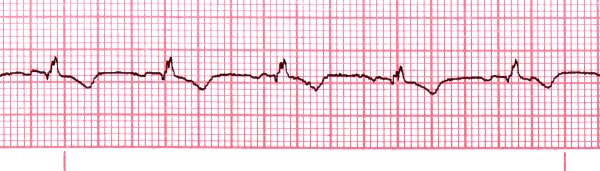
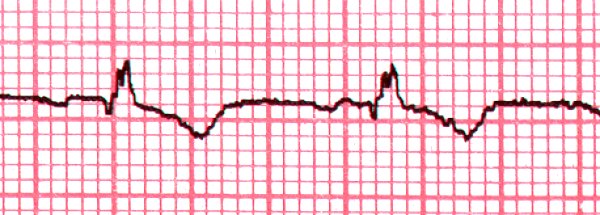
Here are three enlargements at differing magnifications of the same EKG strip.
This is standard pre-printed EKG paper. On it is a recording
made at the
standard speed of 25 mm (or almost exactly one inch) per second.
Note that
the paper is divided into small and large boxes by light and
heavy lines.
Horizontally, the light lines mark intervals of 0.04
seconds, and the heavy
lines mark intervals of five times that: 0.2 seconds.
So, five large boxes
represent a duration of one second. Similarly,
three small boxes represent
a duration of 0.12 seconds. The vertical
scale represents voltage, with each
light line corresponding to 0.1 millivolt.
However, this scale is reliable only
on 12-lead EKG machines, as it is
often altered on other monitors for ease
of observation. Also note
the marks in the bottom margin: they represent
intervals of three seconds. Two of these intervals are a tenth of a minute,
so the number of beats between two of these marks, multiplied by ten,
give the approximate heart rate.
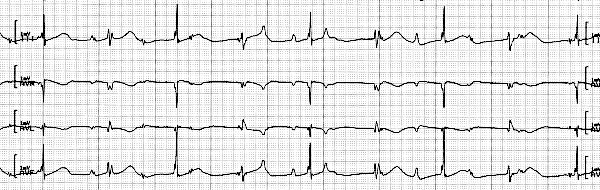
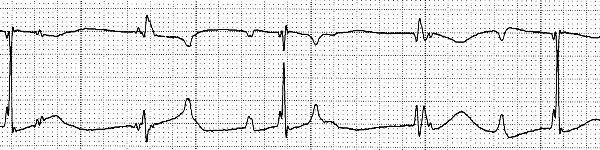
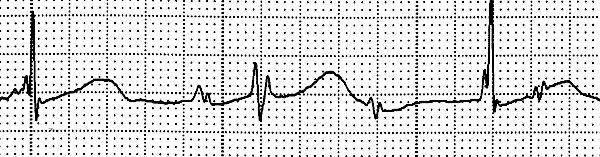
On this recording, the EKG and paper markings are printed together
at the
standard speed of 25 mm (or almost exactly one inch) per second. Note that
the paper is divided by light and heavy dots
to mark intervals of time in the
same increments as pre-printed paper. The lines formed by light dots mark
intervals of 0.04 seconds, and the lines of heavy dots mark intervals of five
times that: 0.2 seconds. So, five large boxes represent a duration of one
second. Similarly, three small boxes represent a duration of 0.12 seconds.
The vertical scale represents voltage, with a calibration marker showing one
millivolt
printed near the right end of the strip. The marks in the top margin
(not seen here) represent intervals of three seconds. Two of these intervals
are a tenth of a minute, so the number of beats between two of these marks,
multiplied by ten, give the approximate heart rate.